Depth of Focus - A Short Introduction by Christopher John Ball

Tweet
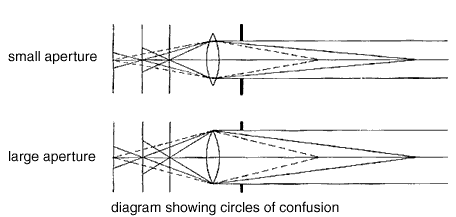
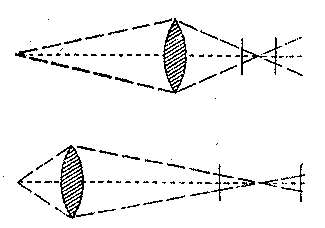
Depth of focus increases as the aperture gets smaller. As the subject is brought nearer to the camera, or you use a longer focal length lens, the depth of focus increases. This is the exact opposite of what happens with depth of field. As can be seen from the diagram below, depth of focus increases for close subjects because the ' cone ' of light rays coming from the lens is longer and more pointed, i.e. looks sharper to the eye.
Not to be confused with depth of field. The difference being that depth of field is the range that the subject can be moved and still be in apparent focus. As explained above, depth of focus being the range that the film can be moved within the film plane and still appear sharp.
Like depth of field, depth of focus extends both in front of the film and behind. The major difference being is that with depth of focus this is equally split 50/50 and not 33.33/66.66.
Practical advantages of depth of focus are mainly geared towards larger format camera's. This is because the 35mm camera utilises shorter focal length lens and requires a smaller acceptable circle of confusion. Therefore the lens has to be more precisely placed, relative to the film plane, than a larger format camera.
Depth of focus becomes useful with larger format camera's because it allows for a greater use of ' camera movements ' - such as rise and fall, swing etc.
Depth of focus is useful in photographic printing as well as in image making. When you stop down the enlarger lens you are increasing depth of focus. This can be used to cancel out any enlarger focusing errors due to the negative ' popping ' , because of the heat of the enlarger bulb, during printing.July 2024 Several books, featuring Christopher John Ball's photographs, are now available through Amazon or click on an image below to purchase via secure payments on lulu.com
Tweet